
Why Understanding How Lubrication Extends Your Garage Door’s Life Can Save You Money
How lubrication extends your garage door’s life is simpler than most homeowners expect — and the payoff is significant. Here’s a quick summary:
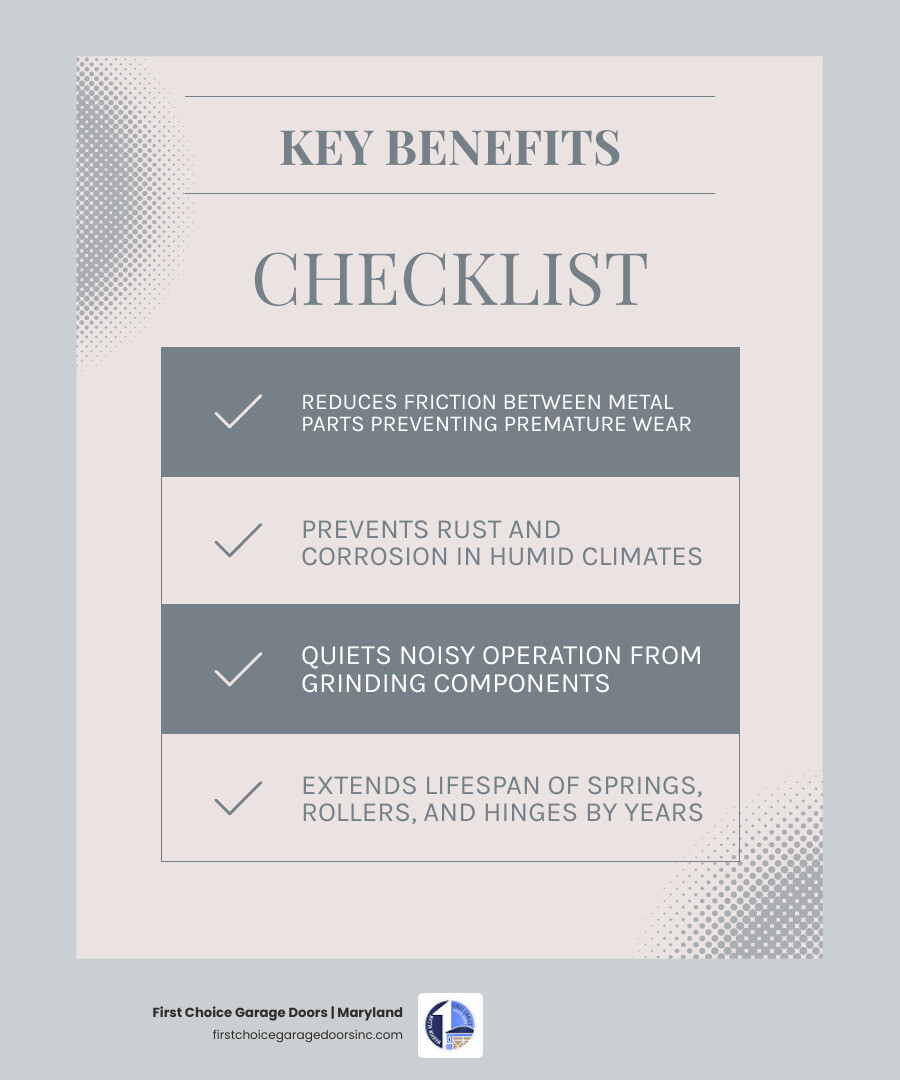
- Reduces friction between metal parts, preventing premature wear
- Prevents rust and corrosion, especially in Maryland’s humid climate
- Quiets noisy operation caused by grinding or squeaking components
- Reduces strain on your opener, helping it last longer
- Extends the lifespan of springs, rollers, and hinges by years
- Prevents costly breakdowns — up to 70% of premature garage door component failures are linked to poor maintenance
Most homeowners don’t think about their garage door until something goes wrong. But by then, the damage is often already done. A door that squeaks, stutters, or strains to open isn’t just annoying — it’s a sign that metal components are grinding against each other, wearing down cycle by cycle.
The good news? A simple lubrication routine, done twice a year, can stop most of that wear before it starts. For Maryland homeowners dealing with humid summers, cold winters, and everything in between, proper lubrication isn’t just helpful — it’s essential.
This guide walks you through exactly which parts need lubrication, which products to use, and how to do it right.
How lubrication extends your garage doors life terms to know:
The Science of Friction: How Lubrication Extends Your Garage Doors Life
To understand why a simple can of spray can save you hundreds of dollars in repair bills, we have to look at the physics of your garage door. Your garage door is the largest, heaviest moving object in your home—often weighing anywhere from 150 to over 300 pounds. Every time you push that button on your wall or click your remote, dozens of individual metal components must work in perfect harmony to lift that massive weight.
Without a protective barrier, these metal parts grind directly against one another. This metal-on-metal contact creates intense friction, which generates heat and microscopic wear. Over time, this friction shaves off tiny bits of metal, weakening structural components until they eventually fail.
When you apply the correct lubricant, you are creating a microscopic protective film between these moving parts. Instead of metal grinding against metal, the components glide smoothly over this liquid barrier. This dramatically reduces the rate of physical wear and tear, keeps the system running quietly, and protects the metal from moisture. For a deeper dive into why keeping things slick is so important, check out our guide on how to Keep It Greasy With Regular Garage Door Lubrication.
Understanding How Lubrication Extends Your Garage Doors Life by Reducing Friction
Every garage door system is rated for a certain number of “cycles.” A cycle represents one full opening and closing of the door. Under ideal conditions, a standard torsion spring might be rated for 10,000 to 15,000 cycles. However, if those coils are dry and rusting, they rub against each other with incredible resistance during every single cycle. This added friction accelerates spring fatigue, easily cutting that lifespan down to 7,000 cycles or fewer.
The mechanical stress of dry operation doesn’t stop at the springs. Dry rollers stick instead of rolling, dragging along the steel tracks. This forces your garage door opener to pull much harder than it was designed to, drawing more electrical current and wearing out its internal gears prematurely. By regularly lubricating your system, you minimize this resistance, ensuring that every cycle puts the absolute minimum amount of stress on the hardware. To learn more about maximizing the lifespan of your entire system, take a look at our Long Live the Door Maintenance Tips for Longevity.
How Lubrication Extends Your Garage Doors Life Against Harsh Maryland Weather
Here in Maryland, our garage doors face a gauntlet of seasonal weather challenges. From the humid, salty air of Easton MD on the Eastern Shore to the heavy summer humidity of Columbia MD and the freezing winter temperatures of Frederick MD, our local climate is incredibly tough on metal components.
In the summer, high humidity acts as a catalyst for rust and corrosion. Rust doesn’t just look bad; it eats away at the structural integrity of your springs, cables, and hinges, making them brittle. A well-lubricated component has a hydrophobic barrier that repels moisture, stopping rust before it can take hold.
In the winter, extreme cold can cause metal to contract and standard greases to harden or become gummy. This increases the load on your opener right when it’s already working harder due to cold temperatures. Applying a high-quality, temperature-resistant lubricant in the autumn prepares your door to glide effortlessly through the freezing winter months. For seasonal advice on getting your door ready for the colder months, read our Garage Door Maintenance Tips to Keep Your Door in Top Shape This Fall.
Key Garage Door Components That Require Regular Lubrication
Not every part of your garage door should be lubricated, and using the wrong product on the wrong part can actually cause more harm than good. To keep your system perfectly balanced and quiet, you need to focus on specific high-wear areas. For an overview of how adjustments and lubrication work together for local homes, see our article on Lubrication and Adjustments for a Happier Annapolis Garage.
Torsion and Extension Springs
Your garage door springs do the heavy lifting. While the opener guides the door, the springs provide the counterbalance tension that actually offsets the door’s weight.
Torsion springs (mounted on a metal shaft above the closed door) wind and unwind tightly. As they do, the coils rub against one another. Without lubrication, this friction creates a loud, rhythmic squeaking and accelerates metal fatigue. Extension springs (which run along the upper tracks on either side) stretch and contract, relying on pulleys that also require lubrication.
Safety Warning: Garage door springs are under extreme tension—enough to cause severe injury or property damage if they snap or are tampered with. While applying a light spray of lubricant to the coils is a safe DIY task, you should never attempt to loosen, tighten, or adjust the springs or their connected hardware yourself.

Rollers and Hinges
Rollers are the wheels that guide your door up and down the tracks. Hinges are the metal brackets that hold the door sections together, allowing them to flex as the door curves around the track.
- Steel Rollers: These contain exposed ball bearings. They require regular lubrication directly into the center bearing core to keep them spinning freely.
- Nylon Rollers: Nylon rollers are highly popular because they operate much quieter than steel. However, they require different care. The nylon wheel face itself is self-lubricating and should never be sprayed with lubricant (as this can cause the roller to slide rather than roll, damaging the wheel). However, if your nylon rollers have exposed steel ball bearings in the center stem, those bearings still need a light shot of lubricant.
- Hinges: Spray the pivot points where the metal leaves of the hinge meet and bend. This prevents the classic “machine-gun” rattling sound when the door opens.
For a comprehensive breakdown of roller and track care, read The Ultimate Guide to Best Lubricant for Garage Door Tracks and Rollers.
Pulleys, Bearings, and Opener Rails
To keep the entire assembly moving smoothly, don’t forget the supporting cast of hardware:
- End-Bearing Plates: Located on the far left and right sides of your torsion spring shaft, these plates house bearings that support the spinning shaft. A dry end bearing is the primary cause of high-pitched screeching.
- Pulleys: On extension spring systems, lubricate the ball bearings at the center of the pulleys.
- Opener Rail: Depending on your opener type, the drive mechanism needs occasional maintenance. Screw-drive openers require a low-temperature lithium grease along the threaded rod. Chain-drive openers benefit from a light coat of lubricant on the chain, while belt-drive openers should never be lubricated on the belt itself (which can cause slipping).
To keep your entire system in peak condition, explore our Garage Door Maintenance Tips to Ensure a Long-Lasting Door.
The Best Lubricants for Your Garage Door (And What to Avoid)
Using the wrong spray on your garage door is one of the most common DIY mistakes we see. Many household lubricants are designed to clean or displace water, not to provide long-lasting lubrication under heavy mechanical loads.
Recommended Lubricants: Silicone vs. White Lithium Grease
To protect your door properly, you should keep two primary types of lubricants on your garage shelf: silicone-based sprays and white lithium grease.
| Lubricant Type | Best Used For | Key Benefits |
|---|---|---|
| Silicone Spray | Rollers, hinges, springs, locks, and rubber seals. | Fast-drying, non-staining, repels moisture, and does not attract dust or agricultural grit. Operates well across extreme temperature ranges (-20°F to over 250°F). |
| White Lithium Grease | Metal-on-metal contact points, screw-drive opener rods, and heavy-duty hinges. | Applies as a liquid to penetrate deep into joints, then sets into a thick, clingy protective grease barrier that won’t drip or wash away. |
Products to Avoid: The Danger of WD-40 and Heavy Oils
If you are holding a classic blue-and-yellow can of WD-40, put it down!
While standard WD-40 is an excellent product for displacing water or cleaning rusty bolts, it is not a long-term lubricant. It is primarily a solvent. When sprayed on garage door hardware, it will temporarily quiet the squeak by cleaning away old grease, but it evaporates completely within a matter of days. Even worse, it strips away whatever protective factory grease was left behind, leaving your metal completely dry and highly vulnerable to rapid wear.
You should also avoid:
- Engine Oil or Motor Oil: Too thin; it will drip off the tracks and springs, staining your garage floor and your cars.
- Heavy Industrial Greases: These are too thick and tacky. In dusty Maryland environments, heavy grease acts like a magnet for dirt, pollen, and debris, turning into an abrasive grinding paste that destroys bearings.
Pre-Lubrication Maintenance Checklist and Step-by-Step Guide
Before you start spraying, you need to prepare the door. Applying fresh lubricant over layers of old dirt and metal shavings is highly ineffective. To make this process easy, we’ve outlined a simple, highly effective routine. For a quick reference guide, check out our post on How Often to Lubricate Your Garage Door 5 Easy Steps.
Pre-Lubrication Inspection Checklist
Take 10 minutes to inspect your door before applying any products. This helps you spot minor wear before it turns into an emergency repair.
- Check the Balance: Disconnect your automatic opener by pulling the red emergency release cord. Manually lift the door halfway and let go. A perfectly balanced door should hover in place. If it slams shut or shoots upward, your springs have lost their proper tension, placing massive strain on your opener.
- Tighten Loose Hardware: The constant vibration of daily use can loosen nuts and bolts. Grab a socket wrench and gently tighten any loose hinges or track brackets.
- Inspect the Safety Sensors: Ensure the photo-eye sensors at the bottom of your tracks are clean, aligned, and free of cobwebs.
- Check the Weatherstripping: Inspect the rubber seals at the bottom and sides of your door for cracks or gaps that could let moisture in.
For a great checklist to use during the spring cleaning season, refer to our Garage Door Maintenance Tips to Follow This Spring.
Step-by-Step Lubrication Process
Once your inspection is complete, follow these steps for a clean, professional application:
- Step 1: Disconnect the Power. Unplug your automatic garage door opener from the outlet to ensure no one accidentally activates the door while your hands are near the moving hardware.
- Step 2: Clean the Tracks. Use a damp rag or a mild degreaser to wipe away dirt, dust, and old grease from the inside of the tracks. Do not lubricate the tracks.
- Step 3: Lubricate the Hinges. Spray a small amount of silicone lubricant directly onto the pivot points of each hinge. Wipe away any excess drips immediately.
- Step 4: Lubricate the Rollers. Use the precision straw applicator to spray silicone lubricant directly into the center ball bearings of each roller. Remember: do not spray the outside wheel of nylon rollers!
- Step 5: Coat the Springs. Spray a light, even coat of silicone lubricant or white lithium spray along the entire length of your torsion or extension springs. You don’t need to soak them; a thin, even coat is perfect.
- Step 6: Lubricate Bearings and Pulleys. Spray the end-bearing plates on both sides of the torsion shaft, as well as any pulleys on extension spring systems.
- Step 7: Distribute and Test. Reconnect the opener power, then manually open and close the door three to four times. This works the lubricant deep into the bearings and hinges, ensuring total coverage.
Frequently Asked Questions about Garage Door Lubrication
How often should I lubricate my garage door?
For most standard residential homes in Maryland, we recommend a thorough lubrication every 6 months (ideally once in the spring and once in the autumn).
However, your schedule should adjust based on usage and climate:
- Heavy Usage: If your household opens and closes the door more than 4–6 times a day, or if you run a business with high-traffic commercial doors, you should lubricate every 3 months.
- Harsh Climates: If you live on the coast in Easton MD where salty humidity is constant, quarterly lubrication provides crucial rust protection.
To see how summer heat and humidity specifically affect your maintenance needs, read our guide on Garage Door Maintenance Tips for Summer.
Should I lubricate my garage door tracks?
No, you should never lubricate your garage door tracks.
This is one of the most common misconceptions in home maintenance. Your rollers are designed to roll smoothly along the tracks, not slide. Applying lubricant to the tracks makes them slippery, which can cause the roller wheels to slide or drag. This flat-spots nylon rollers and can cause the door to slip out of alignment or jump off-track entirely. Furthermore, wet lubricant inside the track acts like flypaper, trapping dust, pet hair, and dirt, eventually forming a thick grime that jams the rollers. Instead of lubricating, simply wipe the tracks clean with a damp cloth or a spray cleaner.
For tips on keeping your door running smoothly during freezing winter conditions, check out our Garage Door Maintenance Tips for Winter.
What are the signs that my garage door needs professional maintenance?
While regular lubrication is an easy DIY task, some issues require the tools and training of a professional technician. You should call us if you notice:
- Persistent Loud Noises: If your door continues to grind, screech, or rattle loudly even after a thorough cleaning and lubrication, your rollers or bearings may be completely worn out and require replacement.
- Slow or Jerky Operation: A door that struggles to open, moves unevenly, or shakes violently as it travels indicates a mechanical imbalance or worn-out cables.
- Unbalanced Door: If your door fails the manual balance test (slams down or shoots up when released halfway), your springs need professional adjustment.
- Frayed Cables or Rusty Springs: If you see visible rust on your springs or notice fraying on the steel lift cables, do not attempt to operate the door. Contact a professional immediately to prevent a dangerous cable snap.
Conclusion
Taking 15 minutes twice a year to properly lubricate your garage door is the single most cost-effective thing you can do to protect your investment. By reducing friction, fighting off Maryland’s coastal and seasonal humidity, and keeping the load on your opener light, you can add years of reliable, whisper-quiet operation to your garage door system.
If your door is still making unusual noises after lubrication, or if you prefer to leave the dirty work to the experts, we are here to help. At First Choice Garage Doors, we provide professional, prompt, and safety-focused maintenance services across Maryland, including Columbia MD, Easton MD, and Frederick MD.
Ready to make sure your garage door is in perfect shape for the seasons ahead? Explore our professional garage door maintenance options, or contact our experienced team today to schedule your comprehensive safety inspection and tune-up!